A Pinus cembra provenance test and its connection with avalanche preventing
Connection with a LIFE-Nature project which are currently implemented in the Northern Carpathians
Ioan Blada
Forest Research and Management Institute of Bucharest
Abstract
Twelve stone pine ( Pinus cembra L.) provenances originating in Alps and Carpathian Mountains were planted at two sites located at high elevation in the Southern and Northern Carpathians , respectively.
At age 14, four traits were measured and statistically analyzed but only height growth and numbers of branches per whorl traits were taken into account as main criteria of selection. Due to their faster growth and their bigger number of branches per whorl, these provenances could be planted in sub-alpine zones because they have a faster ability to colonize the area and to play a significant role in avalanche and soil erosion control.
Analysis of variance, at each location, showed highly significant (p < 0.001) differences between provenances for both height growth and number of branches per whorl. Also, combined analysis, indicated a statistically significant genotype x environment interaction suggesting that the same provenances react differently to the changed environment conditions.
For their faster height growth and number of branches per whorl, the Duncan 's multiple range tests recommend the best provenances to be planted in avalanche areas from the Northern and Southern Carpathians .
Based on these results a LIFE-Nature project, with the European Community financial support, has been implementing, in the Pietrosul Rodnei from Northern Carpathians . The Project major objective is to restoration Pinus cembra / P. mugo / Picea abies habitat in the Pietrosul Rodnei Mountain where the avalanche occurrence is medium to high.
Key words: Carpathians, Pinus cembra, provenance, Picea abies, height growth , snow, avalanche, wooden fences.
Introduction
The Swiss stone pine (Pinus cembra L.) is naturally distributed at high elevation from Alps and Carpathians. The species is a glacier relict that was highly destroyed mainly to create new lands for animal grazing. Many populations have completely disappeared or become scattered trees. The species is still in danger and its protection through conservation is strongly recommended.
The species is important from ecological, social, silvicultural, genetically and many other points of view.
The objective of the paper was to present:
• the results of a Pinus cembra provenance study;
• to recommend the most appropriate Pinus cembra provenances and trees within them to be, in planted in the Pietrosul Rodnei in order to restore the Pinus cembra / P. mugo / Picea abies habitats at sites with avalanche occurrence.
• an avalanche study case concerning climatic factors involved in an avalanche initiation in the Pietrosul Rodnei Mountain from the Northern Carpathians range.;
Materials and methods
Two field trials with Swiss stone pine were laid out in a randomized block design with 12 provenances, three replications and 30 trees per replication in each of the two environments. The two environments are: the Inau Mt. (47 30 Latitude; 24 38 Longitude; 1500 m elevation) from the Northern Carpathians and Surianu Mt. (45 20 Latitude; 22 50 Longitude; 1550 m elevation) from the Southern Carpathians . Of the 12 provenances, seven originate in the Carpathians and five in the Alps Mountains ( Table 1 ). At total age of 14 years or seven after planting, four traits were measured and statistically analyzed ( Table 2 ). However, the discussions will be focused only on two major traits,
i. e. total height growth and the number of branches per whorl.
Climatic data prior and during the avalanches that occurred in the years 1995 and 1996 were taken from the Iezerul Meteorological Station placed at 1780 m elevation and at about 300 m distance from the avalanche tracks.
In the LIFE-Nature Project area and in the area with the avalanche occurrence, as well, the plantations were made by using seedlings of the Inau (No. 5) provenance even though it was on the eighth place in the height growth rank. This provenance was preferred because it is originating in the Rodnei Mountains and therefore it is better than any other acclimatized to local conditions. As the Borsa (No. 6) provenance resulted from self-pollination, it could not be used in the above mentioned objectives.
Results and discussions
Results of the analysis of variance showed significant (p < 0.05) and highly significant (p < 0.01) (p < 0.001) differences between provenances for height growth and number of branches per whorl. These genetic differences were present in both Southern and Northern Carpathians trials ( Table 3 ). The above mentioned results suggest that:
• the differences have a genetic background;
• the growth and number of branches per whorl can be improved;
• selection of some valuable provenances to be used for practical reasons, can be done.
The analysis of variance over locations indicates significant and highly significant differences between provenances in their reaction to the local ecological conditions (Table 4 ). Therefore, one may expect that some provenances can not exhibit similar performances in both test sites and selection should be done according to these local performances.
According to the D uncan ' s (1955) multiple range tests, the mean height growth was distributed into six and seven homogeneous groups at Southern and Northern Carpathians test, respectively ( Table 5 ). The top group from the Southern trial comprises two provenances, i. e. Pietrele (no. 2) originating in the Southern Carpathians and Calimani (no. 4) from the Northern Carpathians . The Pietrele provenance surpassed by 65 % the last in the rank provenance ( Fig. 1 ) suggesting a high range of variation and high possibilities of selection.
The top group from the Northern trial comprises Blunbach Grunalpe (no. 9) followed by the Calimani (no. 4) provenance originating in the Austrian Alps and Northern Carpathians, respectively ( Table 5 ). From the genetic and ecological reasons, this local Calimani provenance should be planted in the Northern Carpathians even though it is less tallest than Blunbach Grunalpe one. Not only this provenance but the next two provenances (Pietrele and Gemenele), originating in Southern Carpathians could be promoted in plantations at high elevation from the Northern Carpathians .
Important differences in mean growth rate were also observed between some individual provenances and the trial mean. For example, in the Northern trial, the first, second, third and the fourth in the rank provenances significantly surpassed the trial mean by 21.5 %, 15.0 %, 8.9 % and 8.5 %, respectively. The poorest in height growth was the provenances No. 6 and 11; their growth rate was 20.0 % and 22.9 %, respectively, under trial mean ( Fig. 2).
These differences in height growth rates are economically important as they sooner play a positive role against avalanche initiation and in addition they cause a greater difference in rate of volume growth. So, according to the obtained results in the Northern trial, only the top four provenances in the rank should be selected for practical reasons while all the others should be discarding ( Fig. 2, lower graph ). Similar results can be observed at the Southern trial
( Fig. 2, upper graph )
The total number of branches per whorl is another major trait to be taken into account from practical stand point. This is because more branches on the tree means a denser crown and a denser crown means a higher capacity of water / snow retention and consequently less danger for avalanche initiation and flooding and soil erosion.
As previously mentioned, highly significant (p < 0.01; p < 0.001) genetic differences between provenances for the number of branches per whorl were found in both Southern and Northern trial ( Table 3). In the Northern trial, the first four provenances in the rank, i. e. No. 3, 4, 7 and 2, exceeded the trial mean by 13.7 %, 12.9 %, 8.8 % and 7.0 %, respectively. All these provenances could be selected and planted at high elevation ( Fig. 3, lower graph ).
Low to high within provenance variation coefficients were found (Table 6 ). In the Southern trial, these coefficients were relative low for total height ranging between 12.7 % and 22.9 %, and high for number of branches per whorl, ranging between 26.6 % and 39.8 %. More or less similar variation coefficients can be noticed in the Northern trial, as well.
At age 14, significant (p < 0.05) and highly significant
(p < 0.01) positive phenotypic correlation between total height and number of branches per whorl, were found ( Table 7 ). This suggests that:
? the above mentioned traits have been controlling by the same group of genes;
? growth improvement through indirect selection, is possible,
i. e. selection for one easy measurable trait, such as number of branches per whorl, will cause a simultaneous improvement in height growth.
Practical implications
The present experiment was conducted to detect genetically most appropriate seed sources or provenances to be planted at high mountain elevations. With the objective in mind, the best provenances are those that demonstrated to have a fast growing and a bigger number of branches per whorl.
The regressions between total growth in height and number of branches per whorl indicated that: the provenances 2, 4, 3 and 9 are the most suitable to be planted in the Southern Carpathians ( Fig. 4) while the provenances 9, 4 and 2 are suitable for the Northern Carpathians ( Fig. 5 ). However, for restoration of Pinus cembra / Pinus mugo / Picea abies habitats in the Pietrosul Rodnei neither Cãlimani nor local Pietrosul but Inau provenance will be planted. This is because the Cãlimani and Pietrosul provenances as well are less appropriate than the Inau one. The Cãlimani provenance is not genetically suitable for Pietrosul because it is placed at about 150 km distance. The Pietrosul (Borsa) provenance, i. e. the local one, also can not be used because only scattered trees occur in that area and for this reason, only self-pollination can not take place. The offspring resulted from self-pollination have a very narrow genetic base and consequently a very low rate of survival.
Conclusions
In conclusion, the total height growth and the number of branches per whorl are the two important traits to be genetically improved, because:
? a faster growing planting stock can earlier play a positive role in field colonization and avalanche control, as well;
? a greater number of branches per whorl give rise to a denser tree crown; trees with such crowns poses a higher capacity of water and snow retention and consequently, less chances for avalanche initiation and for flooding and soil erosion.
? The Inau provenance was recommended to be planted in the LIFE-Nature Project area.
? The results of the present study have already practical applications in the Pietrosul Rodnei in order to restore the Pinus cembra / Pinus mugo / Picea abies habitats and implicitly to prevent avalanche initiation and soil erosion.
? To be efficiently against avalanche initiation, plantations must be associated with dispersed consolidated defense structures placed on the half-upper part of the slope, to break the avalanche from its early stage.
The After LIFE-Conservation Plan
(Annex 2)
This plan develops the actions that were initiated in the years that follow the end of the Pietrosul LIFE project and how the longer term management of the site will be assured.
Taking into account that some threats, such illegally hunting, cutting trees, flowers collection and grazing still may occur, the guarding team main task is to guard continuously the in danger objectives of the Park. The project plantation represents a special area to be guarded because it is placed just near the path that climbs to the Pietrosul Pick.
The chalet is an objective to be guarded because some no educated tourists could damage the building or enter by force inside for sleeping, especially because no accommodation facilities in that zone. Therefore, a ranger who is responsible with plantation takes care almost permanent of the chalet, as well.
In some parts of the plantation, the grass grows faster than the seedlings. In order to save the seedlings, the grass must be cut usually during the August, otherwise during the winter time the snow together with the grass fall on seedlings and suffocate them. In the last week of August this year our two technicians from Caransebes Research Station have cut the grass where the case was.
During our recently cutting the grass inside plantation, some missing seedlings were noticed. In a few days from now, all missing seedlings will be replaced; the Sinaia Nursery still have a lot of seedlings from the same provenance. This action will continue in the next years, if the case.
The plantation evolution process via inventories will made yearly by two members of the working team and the results will be uploaded to the database.
The public awareness is a very attractive action for many people, but mainly students from high school and universities. A plan will be made for this winter and the two films will be displayed. During the summer time many tourist groups will visit our plantation and some of them ask for a guide. The Park scientists are those that fulfill this task but some of the working team members are also involved.
The project manager or his successor will organize an international meeting in 2010 where an indoor session followed by a visit in Pietrosul takes place. Several presentations connected to the National Park but firstly about plantation evolution will be presented during the indoor session and the field trip.
The planned activities
No. |
Action |
Responsible and financial support |
Implementat-ion period |
1 |
Guarding the project area against any destructive actions that could occur |
MRNP |
Permanent |
2 |
Supervising the LIFE Chalet and keeping it in good conditions in order to be used in a civilized manner only by the people involved in both MRNP and LIFE plantation management |
MRNP |
Permanent |
3 |
Replacing the missing seedlings from the LIFE plantation; new seedlings of the same origin available at the ICAS nursery will be used |
ICAS |
2007-2010 |
4 |
Taking care or tending the young LIFE project plantation. This consists in removing the tall weeds and grass or other species that compete the planted seedlings |
ICAS |
2007-2010 |
5 |
Inventory of survival seedlings and recording their health state in order to learn how the plantation evolution will going one; there will be taken pictures film imagery and the results will be used for public awareness and other specific reasons |
ICAS |
2007-2010 |
6 |
Public awareness which consists of: (a) in Power Point presentation of the project results, including the two films, in other institutions than before; (b) distribution all of the available brochures and leaf lets; (c) organizing visits with project plantation where different student groups will attend (d) upon request, CD or DVD with the two films will be distributed to new institutions, including all Romanian National Parks, or people directly interested in the aspects; |
a) ICAS
(b) ICAS
(c) ICAS
(d) ICAS
|
(a) 2007-2008
(b) 2007
(c) 2007-2010 (d) 2007-2008
|
7 |
An international workshop on the implemented LIFE-Nature Pietrosul project will be organized in Borsa / Pietrosul. The evolution process of the four introduced species will be analyzed. |
ICAS, FSAM MRNPI |
September 2010 |
Legend:
MRNP = the Muntii Rodnei National Parc;
ICAS = the Forest Research and Management Institute of Bucharest ;
FSAM = Forest State Administration Maramures
MONITORING OF EVOLUTION PROCESS OF P. CEMBRA SPECIES RE-INTRODUCTION AND P. CEMBRA / P. MUGO / P. ABIES HABITAT RESTORATION TO THE END OF THE PROJECT ( Action D.2)
Introduction
To restore the degraded habitat from Pietrosul, a number of 15550 instead 10000 seedlings were planted, such as: 5000 dwarf pine ( Pinus mugo ), 4350 cembra pine ( Pinus cembra ), 2500 spruce ( Picea abies ) and 3200 rowan ( Sorbus aucuparia ). It is expected that once the planted cembra pine reach about 20 years after planting, cembra pine population starts to produce seeds and to regenerate itself and the cembra pine / dwarf pine / spruce habitat restores. From the project point of view, it is important to learn how this plantation develops. For this reason, the evolution process of the plantation was foreseen in The after LIFE Conservation Plan , so that, the results of successive inventories will let us learn approximately, how many trees per species will survive, let say, at age 20 or any other.
Objectives
This action has the following objectives, such as:
(1) to assess the evolutionary process of P. cembra species re-introduction and of P. cembra / P. mugo / P. abies habitat restoration on 50 ha ;
(2) to create a data base with this evolutionary process of the plantation;
(3) based on the accumulated of evolution data, a working restoration model to be used in other Carpathian zones or in other countries with similar conditions.
M ethods
To get a satisfactory precision, in the year 2005, 10 (instead of three foreseen) permanent sample-plots were established across the project area. Each plot with a circle form of 13 m radius was marked at its centre with a red stick to be seen from distance. In the autumns of the 2005 and 2006 and 2007 years, within each sample-plot an inventory of the seedlings was made according to a five steps scale that took into account the seedling health, as follows:
•A – 100% of seedling is green and has viable terminal shoot and bud;
•B –61 – 80 % of the seedling crown is green, and has viable terminal shoot and bud;
•C –41 – 60 % of the seedling crown is green, and has viable terminal bud;
•D – < 40 % of the seedling crown is green but has a dead terminal shoot;
•E – 100 % of the seedling is dead.
Results
The first and the second assessments were made in 2005 and 2006 years, and survivals and dead seedlings were recorded; however, the survivals were not distributed on the A to D categories. At that time, the plantation average success (%) per species was very high, such as: 97 % in P. cembra and 95 % in P. mugo and P. abies .
The third monitoring was made from 27 to 29 of May, 2007, after snow melting by using the previously mentioned five steps scale. According to this inventory made in the 10 check plots, the following results were obtained:
•the average survival seedlings for cembra pine was as much as 96.3 % but the percent survival varied from plot to plot, i.e. from 93.6 % in plot nine and 100 % in plots number 6, 7, 8 and 10 ( Table. 1) ;
•for dwarf pine ( Table. 2 ), the average survival was slightly lower (but still very high) than in cembra pine, i.e. 94.2 % and variation was between 92.3 % in plot number 4 and 100 % in plot one. The rowan planted in the same whole with the dwarf pine has 96 % survival.
In case of spruce ( Tab. 3 ), the average planting success was 92.2 % and the variation was between 90 % in plot number 8 and 100% in some other five plots.
According to the Romanian legislation 85 % survival is accepted as good and very good over 90 %.
This very high survival owes not only to the species but also to the snow layer that protected the seedlings against frost during the winter period. Therefore, decreasing in survival in the coming years is expected. In addition, because of the snow layer protection, inferences concerning relationship between the survival and elevation, ca not be done at this age.
Concomitantly with the seedling inventory, observation on behavior or resistance to harsh climate conditions was made, and the conclusions on this subject are, as follows:
• as expected, the P. mugo exhibited the highest resistance to the harsh climate conditions from Pietrosul; however, in some sites exposed to the north-west winter winds, not only the planted but also the natural bushes are injured; about 1 % of planted seedlings have suffered;
• P. cembra is the next species with high level of hardiness but not so high as the former species; in some north-west wind exposed slopes, about 3 % of seedlings were affected by cool winter wind and some of these seedlings have recovered and some died;
• when planted above 1500 m elevation, P. abies exhibited highest susceptibility to the winter cool wind; about 8 % of seedlings were injured and most of them have died.
• S. aucuparia , is a not foreseen species in the project, but it was introduced as it is a basic species in the local habitats; it proved to be as resistant as the P. mugo species and survival was as much as 94%..
Conclusions
The year 2007 inventory showed that the survival was very high with the cembra pine in top, followed by dwarf and by spruce;
According to the Romanian Romsilva normative, a survival of 85 % in the first year of planting, is considered as good and very good over 90 %.
It is expected that later one, the survival will decreased.
The previously mentioned results are the first to be included in the plantation database;
As foreseen in The after LIFE Conservation Plan, data of evolution process will continually be recorded, at least up to the year 2010.
Decreasing in survival in the coming years is expected.
Inferences concerning relationship between the survival and elevation, ca not be done at this age.
A working restoration model to be used elsewhere can not be made yet.
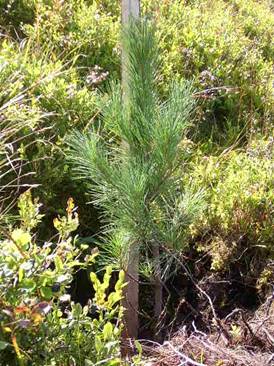
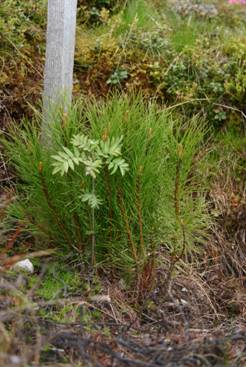
At present healthy state of cembra and dwarf pine is good
Tab.1. Pinus cembra seedlings distribution per check plots and health categories
Plot |
Number of seedlings per plot*
|
In percents
|
|||||||||||||
(No.) |
Elevation (m) |
A |
B |
C |
D |
Survival |
E |
Total |
A |
B |
C |
D |
Survival |
E |
Total |
1 |
1801 |
65 |
3 |
0 |
0 |
68 |
4 |
72 |
90.3 |
4.2 |
0.0 |
0.0 |
94.4 |
5.6 |
100.0 |
2 |
1719 |
36 |
2 |
0 |
0 |
38 |
2 |
40 |
90.0 |
5.0 |
0.0 |
0.0 |
95.0 |
5.0 |
100.0 |
3 |
1695 |
28 |
2 |
0 |
0 |
30 |
1 |
31 |
90.3 |
6.5 |
0.0 |
0.0 |
96.8 |
3.2 |
100.0 |
4 |
1822 |
6 |
2 |
1 |
0 |
9 |
1 |
10 |
60.0 |
20.0 |
10.0 |
0.0 |
90.0 |
10.0 |
100.0 |
5 |
1711 |
34 |
2 |
1 |
0 |
37 |
2 |
39 |
87.2 |
5.1 |
2.6 |
0.0 |
94.9 |
5.1 |
100.0 |
6 |
1630 |
29 |
1 |
0 |
0 |
30 |
0 |
30 |
96.7 |
3.3 |
0.0 |
0.0 |
100.0 |
0.0 |
100.0 |
7 |
1649 |
48 |
3 |
0 |
1 |
52 |
0 |
52 |
92.3 |
5.8 |
0.0 |
1.9 |
100.0 |
0.0 |
100.0 |
8 |
1651 |
41 |
2 |
1 |
1 |
45 |
0 |
45 |
91.1 |
4.4 |
2.2 |
2.2 |
100.0 |
0.0 |
100.0 |
9 |
1673 |
83 |
3 |
2 |
0 |
88 |
6 |
94 |
88.3 |
3.2 |
2.1 |
0.0 |
93.6 |
6.4 |
100.0 |
10 |
1651 |
14 |
2 |
0 |
0 |
16 |
0 |
16 |
87.5 |
12.5 |
0.0 |
0.0 |
100.0 |
0.0 |
100.0 |
Total |
|
384 |
22 |
5 |
2 |
413 |
16 |
429 |
89.5 |
5.1 |
1.2 |
0.5 |
96.3 |
3.7 |
100.0 |
*The plot radius was as much as 26 m
Tab.2. Pinus mugo seedlings distribution per check plots and health categories
Plot |
|
Number of seedlings per plot*
|
In percents
|
||||||||||||
(No.) |
Elevation |
A |
B |
C |
D |
Survival |
E |
Total |
A |
B |
C |
D |
Survival |
E |
Total |
1 |
1801 |
1 |
0 |
0 |
0 |
1 |
0 |
1 |
100 |
0 |
0 |
0 |
100.0 |
0.0 |
100 |
2 |
1719 |
72 |
1 |
0 |
0 |
73 |
4 |
77.0 |
93.5 |
1.3 |
0.0 |
0.0 |
94.8 |
5.2 |
100 |
3 |
1695 |
39 |
0 |
1 |
0 |
40 |
2 |
42.0 |
92.9 |
0.0 |
2.4 |
0.0 |
95.2 |
4.8 |
100 |
4 |
1822 |
38 |
6 |
3 |
1 |
48 |
4 |
52.0 |
73.1 |
11.5 |
5.8 |
1.9 |
92.3 |
7.7 |
100 |
5 |
1711 |
0 |
0 |
0 |
0 |
0 |
0 |
0.0 |
0 |
0 |
0 |
0 |
0 |
0 |
0.0 |
6 |
1630 |
0 |
0 |
0 |
0 |
0 |
0 |
0.0 |
0 |
0 |
0 |
0 |
0 |
0 |
0.0 |
7 |
1649 |
0 |
0 |
0 |
0 |
0 |
0 |
0.0 |
0 |
0 |
0 |
0 |
0 |
0 |
0.0 |
8 |
1651 |
0 |
0 |
0 |
0 |
0 |
0 |
0.0 |
0 |
0 |
0 |
0 |
0 |
0 |
0.0 |
9 |
1673 |
0 |
0 |
0 |
0 |
0 |
0 |
0.0 |
0 |
0 |
0 |
0 |
0 |
0 |
0.0 |
10 |
1651 |
0 |
0 |
0 |
0 |
0 |
0 |
0.0 |
0 |
0 |
0 |
0 |
0 |
0 |
0.0 |
Total |
|
150 |
7 |
4 |
1 |
162 |
10 |
172.0 |
87.2 |
4.1 |
2.3 |
0.6 |
94.2 |
5.8 |
100 |
*The plot radius was as much as 13 m
Tab. 3 Picea abies seedlings distribution per check plots and health categories
|
|||||||||||||||||
Plot |
|
Number of seedlings per plot* |
In percents |
||||||||||||||
(No.) |
Elevation |
A |
B |
C |
D |
Survival |
E |
Total |
A |
B |
C |
D |
Survival |
E |
Total |
||
1 |
1801 |
8 |
6 |
6 |
2 |
22 |
3 |
25.0 |
36.4 |
24.0 |
24.0 |
8.0 |
92.4 |
12.0 |
104.4 |
||
2 |
1719 |
4 |
2 |
0 |
0 |
6 |
0 |
6.0 |
66.7 |
33.3 |
0.0 |
0.0 |
100.0 |
0.0 |
100.0 |
||
3 |
1695 |
1 |
0 |
0 |
0 |
1 |
0 |
1.0 |
100.0 |
0.0 |
0.0 |
0.0 |
100.0 |
0.0 |
100.0 |
||
4 |
1822 |
1 |
0 |
0 |
0 |
1 |
0 |
1.0 |
100.0 |
0.0 |
0.0 |
0.0 |
100.0 |
0.0 |
100.0 |
||
5 |
1711 |
42 |
17 |
2 |
1 |
62 |
5 |
67.0 |
62.7 |
25.4 |
3.0 |
1.5 |
92.5 |
7.5 |
100.0 |
||
6 |
1630 |
66 |
9 |
0 |
0 |
75 |
6 |
81.0 |
81.5 |
11.1 |
0.0 |
0.0 |
92.6 |
7.4 |
100.0 |
||
7 |
1649 |
25 |
5 |
1 |
3 |
34 |
3 |
37.0 |
67.6 |
13.5 |
2.7 |
8.1 |
91.9 |
8.1 |
100.0 |
||
8 |
1651 |
3 |
4 |
2 |
0 |
9 |
1 |
10.0 |
30.0 |
40.0 |
20.0 |
0.0 |
90.0 |
10.0 |
100.0 |
||
9 |
1673 |
1 |
0 |
0 |
0 |
1 |
0 |
1.0 |
100.0 |
0.0 |
0.0 |
0.0 |
100.0 |
0.0 |
100.0 |
||
10 |
1651 |
2 |
1 |
0 |
0 |
3 |
0 |
3.0 |
66.7 |
33.3 |
0.0 |
0.0 |
100.0 |
0.0 |
100.0 |
||
Total |
|
153 |
44 |
11 |
6 |
214 |
18.0 |
232.0 |
65.9 |
19.0 |
4.7 |
2.6 |
92.2 |
7.8 |
100.0 |
||
*The plot radius was as much as 13 m
PRERGATIREA PLANULUI TEHNIC DE REFACERE A HABITATULUI
PREPARATION OF TECHNICAL PLAN FOR HABITAT RESTORATION
(Actiunea A.2)
Preparation of technical management plan aiming at P. cembra species re-introduction and P. cembra / P. mugo / P. abies habitat restoration (Action A.2)
Documentare privind împadurirea terenului din Zanoaga Mica
1. Titlul proiectului
Refacerea habitatelor forestiere din Rezervatia Biosferei Pietrosul Rodnei
2. Localizarea
Rezervatia Biosferei Pietrosul Rodnei este amplasata în zona versantului nordic al vârfului Pietrosul ( 2 303 m ) din muntii Rodnei, cuprinzând caldarile glaciare Zanoaga Mica, Zanoaga Mare si partea superioara a vaii Pietroasele. Rezervatia este una dintre cele noua unitati ale Parcului National Muntii Rodnei . Reintroducerea zâmbrului, molidului si jneapanului se va face în caldarea Zanoaga Mica.
3. Descrierea statiunii
Suprafata parcului este de 46 399 ha, cea a rezervatiei de 6 415 ha, iar suprafata efectiva ce va fi plantata cu zâmbru, molid si jneapan este de 50 ha.
Caldarea Zanoaga Mica este amplasata pe versantul nordic al vârfului Pietrosul, între 1600 si 1900 metri altitudine, cu o panta ce variaza între 25 0 si 50 0 . Coordonatele geografice medii sunt 47 0 37' latitudine nordica, 24 0 40' longitudine estica, 1795 metri altitudine.
Din cele 6 415 ha ale rezervatiei, 3 903 ha sunt acoperite de padure si 2 512 ha cu pajiste alpina si stâncarie. Speciile lemnoase formeaza frecvent amestecuri. În zona superioara (între 1800-1990 m) pe pante cu înclinatie mare predomina Pinus mugo în amestec cu P. Cembra , iar în zona inferioara (între 16001800 m) pe pante cu înclinare mai mica pe care stratul de sol este mai gros, predomina amestecul de Pinus cembra cu Picea abies cu pâlcuri de P. Mugo . În trecut P. cembra forma o populatie naturala întinsa, dar în prezent au mai ramas doar circa 200 de exemplare izolate cu vârste foarte mari. În aceste conditii si-a pierdut capacitatea de polenizare încrucisata si regenerare astfel încât populatia este pe cale de disparitie.
În trecut proportia P. cembra , P. mugo si P. abies era 15%, 25% si respectiv 26%, iar în prezent s-a ajuns la 1%, 20% si respectiv 21%. Limita superioara a padurii s-a deteriorat dramatic, a coborât cu 150-300 m, habitatele sunt puternic degradate datorita influentei umane.
4. Factori destabilizatori ai vegetatiei
Desi zona cuprinsa în Rezervatia Biosferei Pietrosul Rodnei a fost declarata arie protejata înca din 1932, nu s-au luat masuri efective de protectie a habitatelor, acestea fiind afectate continuu de activitatile populatiei locale si de catre turisti. Chiar si dupa declararea zonei Rezervatie a Biosferei , principiile acesteia nu au fost respectate.
Pasunatul intensiv, taierile de masa lemnoasa pentru foc si constructie, exploatarea jneapanului pentru extragerea uleiurilor volatile, colectarea de fructe si plante, turismul, au dus la o degradare continua a tuturor habitatelor, cu efecte negative asupra florei si faunei locale.
Dintre habitatele forestiere, cel al zâmbrului a fost cel mai puternic afectat. P. cembra este singurul arbore de talie mare dintre speciile lemnoase din zona alpina, acesta a fost aproape complet distrus, astfel încât, la ora actuala doar 1% din aria initiala mai este ocupata de acesta, doar aproximativ 200 de arbori cu vârste foarte înaintate au mai supravietuit. Datorita faptului ca exemplarele ramase sunt izolate, distanta dintre ele împiedicând polenizarea încrucisata aproape complet, apare astfel fenomenul de auto-polenizare, care în timp duce la eroziune genetica, reducând variabilitatea si adaptabilitatea populatie, ducând la disparitia populatiei.
Aceleasi conditii au afectat si habitatele molidului si jneapanului. Majoritatea arborilor din zona alpina si sub-alpina, au fost taiati de catre localnici si ciobani pentru a mari suprafata pasunilor, pentru lemn de foc si constructie. Oamenii care locuiesc pe Valea Pietroasele sunt principalii beneficiari ai masei lemnoase.Ca rezultat limita superioara a padurii a coborât cu 150-300 m, cedând locul pajistilor si zonelor erodate. La aceasta s-a adaugat în ultimul deceniu o puternica doborâtura de vânt.
Acestea au avut un puternic efect asupra habitatului populatiilor de P. cembra , P. mugo si P. abies din zona, cu repercusiuni asupra tuturor speciilor de plante si animale din acest habitat, asupra tuturor functiilor si mecanismelor acestuia. De exemplu specia Rhododendron hirsutum , subarbust ce creste în asociatie cu zâmbrul a disparut aproape complet.
5. Necesitatea lucrarii
Ca rezultat a degradarii habitatelor din Pietrosul Rodnei se impun urgente masuri de refacere a starii naturale a acestora.
Prin actiunea de plantare în caldarea Zanoaga Mica, a 50 de ha cu P. cembra, P. abies si P. mugo, se urmareste refacerea capacitatii de înmultire naturala a acestor specii, creând un nucleu de rezistenta care va permite extinderea ulterioara în toata zona initial ocupata de acestea. Fiind specii fundamentale, creatoare de habitat, refacerea unei populatii stabile va duce la ameliorarea conditiilor stationale si pentru celelalte specii de plante si animale, creând astfel conditii cât mai apropiate de cele initiale.
Totodata trebuie luate importante masuri de conservare a zonei, prin implementarea unui plan de management a întregului Parc, în conformitate cu functiile sale si cu notiunea de Rezervatie a Biosferei.
Populatia locala trebuie implicata si educata în vederea utilizarii durabile a resurselor naturale ale zonei, cu pastrarea integritatii acestora si accentuarea functiei protective si generatoare de servicii a capitalului natural.
6. Solutia de împadurire
În zona în care se va face plantarea, în prezent este acoperita de tufarisuri izolate de P. mugo, Salix caprea, Alnus viridis si Sorbus aucuparia . P. cembra este aproape inexistent iar P. abies este prezent mai ales în partea inferioara suprafetei vizate. Vegetatia subarbustiva si ierboasa este reprezentata de Vaccinium myrtilus, V. vitis-idaea si un strat erbaceau bine dezvoltat. Datorita covorului vegetal existent, pantei puternic înclinate (între 25 0 si 50 0 ) si solului stâncos în multe locuri cu stâncarie la suprafata, operatiunile de plantare vor fi extrem de dificile.
Vegetatia initiala era alcatuita din specii arborescente care formau un amestec intim, dar nu foarte dens.
Proiectul îsi propune sa refaca habitatul initial, cu o structura similara folosind pentru plantare puieti originari din aceeasi zona montana. Se vor planta puieti de P. cembra , P. mugo si P. abies în trei reprize, zâmbru si molidul în 2004 pe 25 ha si în 2005 pe 25 ha, iar jneapanul în 2006 pe întreaga suprafata.
6.1. Originea puietilor
Puietii de P. cembra sunt originari din populatia naturala din zona Vârfului Ineu, din acelasi masiv. P. cembra forma populatii naturale pe tot cuprinsul Muntilor Rodnei, înainte ca factorii enuntati sa restrânga aria sa de raspândire în acest masiv. De aceea populatia din zona Vârfului Ineu are aceleasi însusiri genetice si aceleasi cerinte ecologice ca si cea din zona Vârfului Pietrosul, unde se va realiza plantarea. Puietii au 5-6 ani, si au fost crescuti în pungi mari de plastic pe humus brut, în pepiniera Institutului de Cercetari si Amenajari Silvice la Sinaia. Fiecare puiet + punga cu pamânt are 5-6 kg. Faptul ca puietii au radacina protejata si ca sunt mai înaintati în vârsta, asigura succesul operatiunii de plantare.
Puietii de P. abies sunt originari din zona Pietrosul, foarte aproape de locul plantarii. Materialul a fost produs local, la Ocolul Silvic Borsa, în pungi mari de plastic cu pamânt la radacina si au 3 ani.
Puietii de P. mugo îsi au originea tot în zona Pietrosului, dar au fost crescuti în pungi de plastic cu pamânt la radacina în pepiniera Institutului la Sinaia. Puietii vor avea 6 ani în 2005 când vor fii plantati.
Materialul pentru plantat a fost produs respectând principiile genetice si ecologice si este disponibil pentru a fi plantat în 2004.
6.2. Suprafata de plantat
Din cele 50 de ha ce vor fi plantate, 25 vor fi ocupate de zâmbru si 25 de molid, jneapanul va fi plantat ulterior aleator, printre zâmbru si molid si va acoperi toata suprafata de 50 de ha. Arborii existenti pe suprafata considerata (desi degradati, si multi cu vârste înaintate) vor ramâne în compozitia viitorului arboret. Tufarisul foarte des de Vaccinium sp. si bogatul strat erbaceu creeaza anumite probleme pentru plantare.
6.3. Dispozitiv de plantare
Plantarea puietilor se va face la distante de aproximativ 10 x 10 m între puieti, se va evita folosirea unei scheme fixe de plantare. Astfel, în intentia de a recrea, pe cât posibil, vechiul habitat, puietii vor fii plantati conform modelului natural de crestere a unui asemenea arboret, evitându-se plantarea într-un dispozitiv regulat. Datorita configuratiei terenului, plantarea la distante fixe nu este posibila, terenul nu este liber de vegetatia preexistenta, care va ramâne si în viitor, exista stâncarie la suprafata si panta este mare.
6.4. Desime puieti
Se vor planta 100 puieti la ha, deci 5000 pe întreaga suprafata, din acestia 2500 vor fi de P. cembra si 2500 de P. abies . În vederea refacerii zonei cât mai aproape de starea naturala anterioara, 5000 de puieti de P. mugo vor fi plantati (în aceeasi suprafata de 50 de ha), în mod neregulat printre celelalte doua specii arborescente, astfel ca acestia nu vor ocupa alta suprafata decât cea plantata anterior cu zâmbru si molid. Plantarea ulterioara a jneapanului va grabi realizarea starii de masiv si prin aceasta realizarea unui covor protector asupra terenului, care va proteja solul si va conduce la restaurarea conditiilor naturale originale.
6.5. Operatii
• Confectionarea picheti : acestia sunt de 1 m lungime, ascutiti la un capat, confectionati din cherestea de molid;
• Pichetare: pentru identificarea usoara a locului în care se va efectua plantarea, si amplasarea ulterioara a puietului, fiecare din cele 10000 de vetre (gropi) va fi marcata cu câte un pichet;
• Pregatirea terenului pentru plantat: plantarea puietilor se va face toamna, dar datorita ierbii înalte, stratului de Vaccinium si solului compact, este foarte dificila pregatirea terenului de plantat la acel moment. Datorita acestui fapt în primavara fiecarui an (2004, 2005) se va pregati terenul în vetre de 80 x 80 cm, cu sapa forestiera.
• Pregatirea si transportul puietilor: Puietii au fost pregatiti în pepiniera Institutului la Sinaia (zâmbru si jneapan) si în pepiniera la Borsa (molidul), au radacina protejata, fiind crescuti în pungi cu pamânt. Zâmbrul si molidul pot fi plantati imediat iar jneapanul va fi apt pentru plantat în 2006. Puietii (cu tot cu punga si pamânt la radacina) vor fi transportati cu camionul de la Sinaia la Borsa si din Borsa cu tractorul pâna în caldarea Zanoaga. Manipularea lor se face cu grija pentru a proteja puietii si pentru a pastra integritatea balotului de pamânt. Se va avea de asemenea grija la transportul cu tractorul, datorita dificultatii drumului, pantei accentuate si greutatii puietilor.
• Plantarea efectiva si operatiunile asociate: Plantarea puietilor se va face în toamna anilor 2004, 2005 si 2006, pe 25 ha, 25 ha si respectiv 50 ha (jneapanul va fi plantat pe toata suprafata, printre ceilalti puieti). Fiecare puiet va fi plantat într-o groapa de 20 x 20 x 25 cm, executata în vetrele anterior pregatite. Operatiunile asociate plantarii sunt:
• distribuirea puietilor la gropi;
• transport pamânt de împrumut la groapa (acolo unde acesta este necesar);
• plantarea efectiva inclusiv sapatul gropilor.
7. Urmarirea rezultatelor
Dupa realizarea lucrarilor de plantare se va continua cu monitorizarea dezvoltarii puietilor plantati pâna în momentul realizarii starii de masiv. În acest interval se vor executa si lucrari de îngrijire (descoplesiri, refacerea vetrelor, etc.) dupa necesitate. Având în vedere ca puietii au vârsta de 5- 6 ani si radacina protejata, procentul de reusita al lucrarii va fi mare.
8. Rezultate scontate
Refacerea vegetatiei naturale si a habitatului acesteia, prin plantarea zâmbrului, molidului si jneapanului. Ameliorarea conditiilor de viata pentru toate speciile de plante si animale existente în zona, urmata de desfasurarea normala a proceselor naturale.
Aparitia polenizarii încrucisate normale între arborii din noua generatie (dupa aproximativ 20 de ani, când exemplarele de P. cembra vor fi mature), procesul de regenerare naturala va fi restabilit în Zanoaga Mica, zâmbrul se va putea raspândi treptat si în zona adiacenta.
Prevenirea si limitarea formarii avalanselor în zona.